
Hamida Prospect High-Priority Gold Exploration, located in the Shalateen area of Egypt’s Red Sea Governorate, demonstrates excellent potential for orogenic gold mineralization. Our comprehensive surface sampling program across quartz veins, shear zones, and extensive alteration systems has returned multiple gold anomalies. Consequently, Hamida represents a compelling exploration target within the northern Arabian-Nubian Shield.
Introduction to the Hamida Gold Prospect
Situated in the strategic Shalateen region, the Hamida Prospect lies within a highly prospective corridor known for both historic and modern gold occurrences. Furthermore, the project benefits from excellent exposure of Cretaceous Nubian Sandstone and underlying Neoproterozoic basement rocks of the Arabian-Nubian Shield (ANS). This geological terrane ranks among the world’s richest gold provinces.
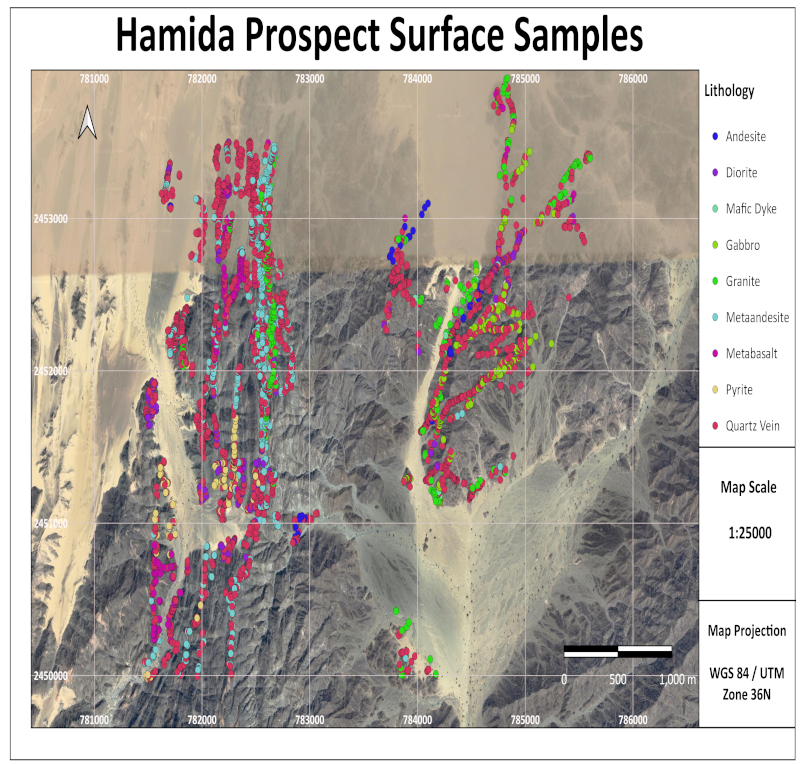
The surface exploration dataset includes 4,515 samples with detailed lithological descriptions, structural measurements, and fire assay gold results. Gold mineralization is primarily hosted within quartz veins, silicified alteration zones, and shear-related structures. In addition, these structures contain iron oxides, sulfides, carbonates, and pathfinder minerals such as malachite and galena.
Geological Setting of Hamida Surface Sampling
The Hamida area exemplifies the classic Eastern Desert gold environment. It contains Cretaceous Nubian Sandstone, which may host unconformity-related or covered targets. Beneath this sequence lie Neoproterozoic basement terranes of the Arabian-Nubian Shield.
These basement rocks consist of island-arc metavolcanics, ophiolites, and late-orogenic intrusions. Moreover, Pan-African tectonic events strongly deformed these units and created favorable structural pathways for hydrothermal fluids.
Gold mineralization is structurally controlled by major shear zones, faults, and quartz-carbonate vein systems. Additionally, common hydrothermal alteration includes silicification, sericitization, chloritization, carbonatization, pyritization, and abundant iron oxides such as hematite, limonite, and goethite.
Dominant lithologies identified during sampling include quartz veins, which represent the primary gold host. Metasediments, gabbro, and metabasalt also display varying degrees of alteration. Furthermore, pyritic zones, diorite, and granite-hosted alteration systems occur throughout the prospect area.
The project area also exhibits extensive mylonitic and foliated shear zones. As a result, permeability and fluid flow were enhanced during mineralizing events. Therefore, Hamida remains highly prospective for gold mineralization.
These geological features align closely with known gold systems in the Shalateen-Halayeb Triangle. Likewise, they resemble productive prospects elsewhere in Egypt’s southern Eastern Desert.
Why Hamida Surface Sampling Results Are Promising
Surface sampling at the Hamida Prospect identified widespread gold anomalism across several zones of interest. Therefore, multiple areas have been classified as high-priority exploration targets.
The mineralization is mainly associated with smoky quartz veins, iron oxide alteration, sulfide minerals, and carbonate-rich zones. Moreover, several locations contain visible malachite staining. This observation indicates the presence of copper mineralization together with gold pathfinder elements within the vein systems.
The continuity of anomalous mineralization along strike is particularly encouraging. In addition, altered and mineralized zones occur across a broad area. Consequently, the prospect may host both high-grade vein-controlled mineralization and larger-scale bulk-tonnage exploration targets.
Conclusion
The Hamida Prospect in the Shalateen region stands out as a promising gold exploration opportunity within Egypt’s Eastern Desert. The project contains robust quartz vein-hosted mineralization, extensive hydrothermal alteration systems, and multiple gold anomalies identified through systematic surface sampling.
Furthermore, the prospect offers excellent discovery potential along the Nubian Sandstone-basement contact and within major shear zones of the Arabian-Nubian Shield. Therefore, Hamida remains a priority target for continued exploration and resource definition.
About AFAQ Mining
AFAQ Mining is an Egyptian mineral exploration and development company focused on advancing high-potential gold assets within the Arabian-Nubian Shield — one of the world’s most prospective regions for gold mineralization. The company’s flagship asset, the Romeit Project, is located within the West Elbah concession.
For more information, please Contact Us