
Arabian Nubian Shield: The Geological Heart of Gold Exploration
Gold has shaped civilizations for thousands of years, and few geological regions have contributed more to its discovery than the Arabian Nubian Shield. Spanning northeastern Africa and the Arabian Peninsula, this ancient Precambrian terrane hosts world-class gold deposits, base metals, and critical mineral resources that continue to attract global exploration investment. Understanding the Arabian Nubian Shield is essential for appreciating Egypt’s growing role as one of the world’s most promising mining and mineral exploration destinations.
What is the Arabian Nubian Shield?
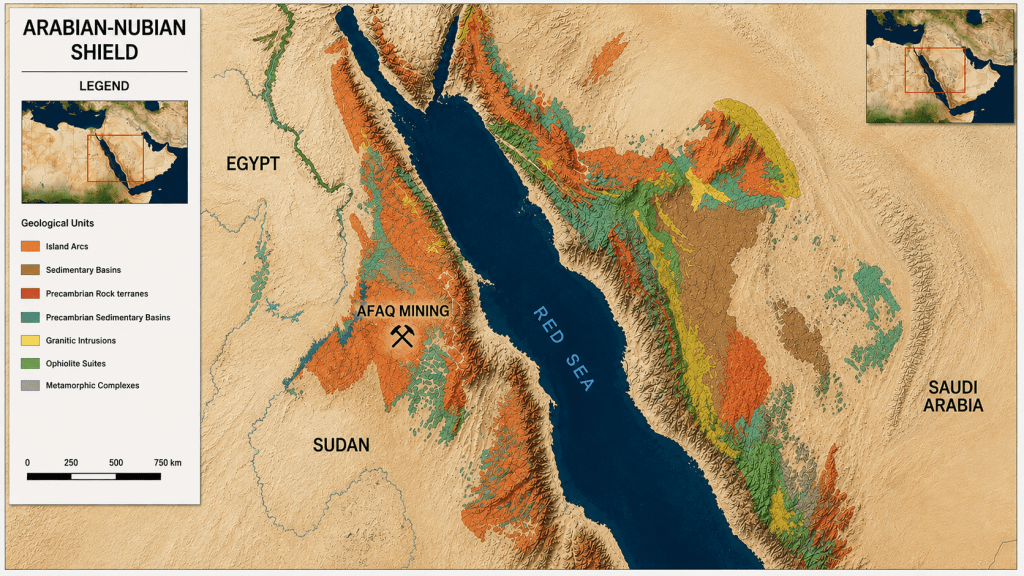
The Arabian Nubian Shield (ANS) is one of the world’s most prospective Precambrian terranes for gold and base-metal exploration. Stretching across northeastern Africa and the Arabian Peninsula, this ancient geological province has become the focus of modern mineral exploration due to its exceptional concentration of gold deposits, volcanogenic massive sulfide (VMS) systems, and orogenic mineralization. Egypt’s Eastern Desert forms a major part of the shield, attracting renewed exploration by companies including AFAQ Mining.
Geological Evolution
The Arabian Nubian Shield formed during the Neoproterozoic Era (approximately 900–550 Ma) through the Pan-African Orogeny. Arc accretion, subduction, metamorphism, granitic intrusions, and hydrothermal alteration created favorable conditions for mineral deposits.
Major Rock Units
Key lithologies include ophiolites, island arc volcanics, metasedimentary sequences, granitic intrusions, and regional shear zones that host many gold deposits.
Arabian Nubian Shield Mineralization
Major deposit styles include orogenic gold, VMS, porphyry copper, epithermal gold, chromite, nickel sulfides, iron oxide deposits, and rare earth occurrences. Structural controls such as shear zones and quartz veins are critical exploration targets.
Arabian Nubian Shield Gold Deposits
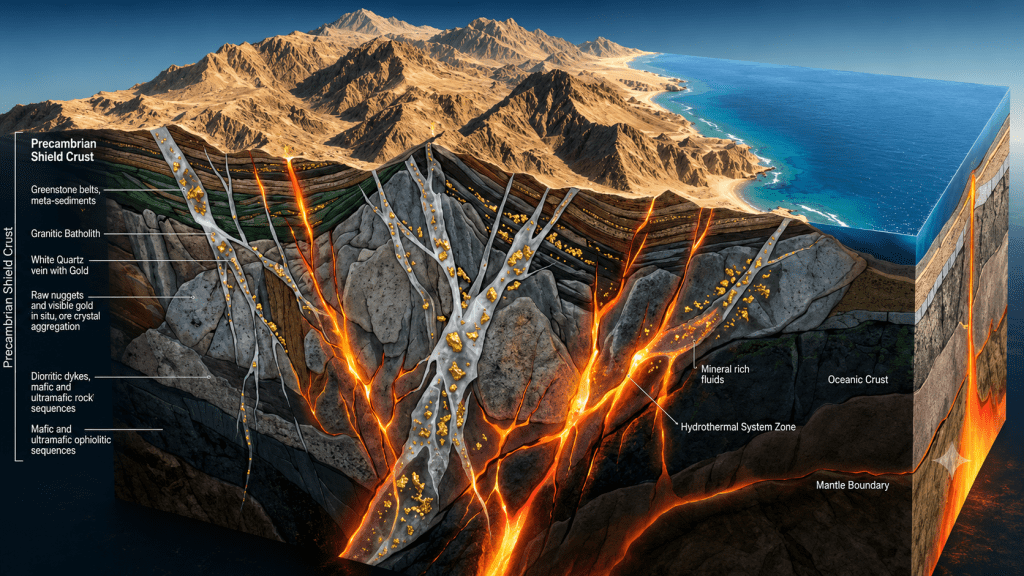
The Arabian Nubian Shield gold deposits rank among the most significant mineral resources within the Neoproterozoic terranes of Africa and the Middle East. Gold mineralization is primarily associated with orogenic gold systems, which formed during the late stages of the Pan-African Orogeny. These deposits are structurally controlled and are commonly hosted within major shear zones, quartz veins, altered metavolcanic rocks, and greenstone belts.
In Egypt, the Eastern Desert contains hundreds of ancient gold workings, many dating back to the Pharaonic period.
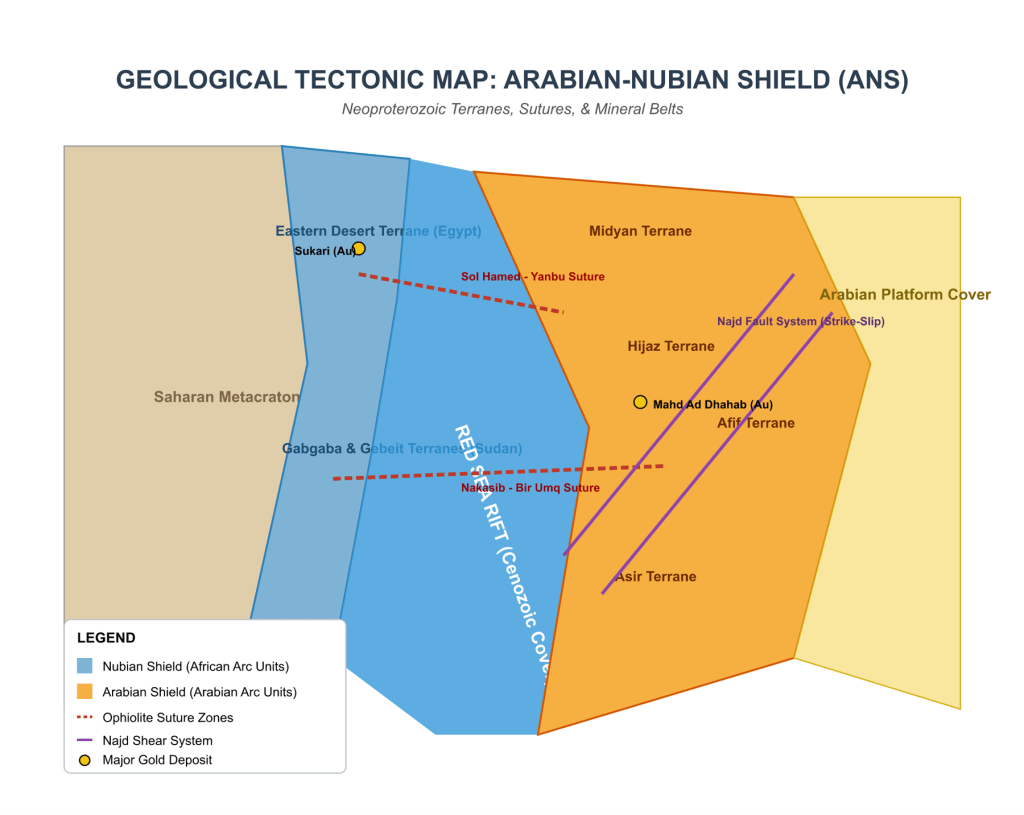
Characteristics of Arabian Nubian Shield Gold Deposits
- Quartz-carbonate vein systems
- Regional shear zones and fault corridors
- Hydrothermal alteration halos
- Sulfide-bearing metavolcanic host rocks
- Strong structural deformation
- Association with granitic intrusions
These features provide geologists with valuable exploration vectors. Modern exploration integrates geological mapping, geochemistry, airborne geophysics, remote sensing, and structural analysis.
AFAQ Mining’s Contribution
As exploration activity accelerates across Egypt’s Eastern Desert, AFAQ Mining is contributing to the systematic evaluation of one of the world’s most prospective geological provinces. The company’s exploration activities are focused within Egypt’s South Eastern Desert, part of the Arabian Nubian Shield, where geological conditions are highly favorable for gold mineralization.
Knowledge Sharing and Industry Collaboration
The continued advancement of mineral exploration depends not only on fieldwork but also on the exchange of scientific knowledge and industry expertise. Events such as the Egypt Mining Forum bring together geologists, mining companies, investors, government representatives, and technical experts. Dr. Hassan Mohy is going to participate in the Egypt Mining Forum, contributing to discussions that highlight the importance of advancing exploration across the Arabian Nubian Shield.
Conclusion
The Arabian Nubian Shield remains one of the world’s premier Precambrian metallogenic provinces. From an exploration perspective, structural geology, hydrothermal alteration, geochemistry, geophysics, and remote sensing should be integrated to maximize discovery success.